City Council Coverage / Meeting Recap
Woodstock Sets Course on Trash Contract, Roundabout Design and Fire Expansion at March 16 Work Session
Based on the official minutes; council directed staff to bring solid waste bids back for a vote March 23; fire accreditation pursuit, downtown zoning overhaul and PUD framework also dominated discussion
Woodstock Community News Staff||7 min read
Updated
Woodstock City Council members left Monday's work session with a clear direction on several fronts that will directly affect daily life in the city, from who picks up residents' garbage to how traffic flows through a congested stretch near downtown to how quickly a fire truck can reach a neighborhood in an emergency.
The March 16 session at The Chambers at City Center drew a full complement of department heads and staff alongside Mayor Michael Caldwell and all six council members. No formal votes were taken, consistent with the work session format, but the evening produced consequential guidance across six presentation items spanning infrastructure, land use, public safety and city communications. City Manager Jeff Moon opened the meeting with the Pledge of Allegiance, and Pastor Keenan Brinson of Mount Olive Missionary Baptist Church delivered the invocation.
Mayor Caldwell amended the published agenda order at the outset, moving the Dobbs Road intersection presentation, originally listed fourth, to the top of the discussion queue.
**The Trash Question**
The most immediately consequential discussion of the evening centered on residential solid waste collection, a service that touches every household in the city. The city's current contract with Waste Management expires June 30, and Moon told council members that staff had completed a formal request-for-proposals process and returned with four options: award the contract to the lowest bidder, stay with incumbent Waste Management, shift to an open franchise system with service zones, or decline to award the bid at all.
Moon recommended council focus on the first two. Option 1, awarding to the lowest bidder, identified as Red Oak, would mean a rate increase of approximately $11.64 per quarter for residents. Option 2, renewing with Waste Management, would carry a steeper increase of roughly $26.46 per quarter, but would avoid the disruption of switching providers: no new cart distribution, no customers setting up new accounts, no learning curve for either side.
Moon said he did not recommend Options 3 or 4, citing likely higher rates from lost volume, increased operational costs and the prospect of multiple competing trucks running routes through city neighborhoods, a nuisance and a safety concern on residential streets.
Council members pressed both finalists on the details. Council Member David Potts asked about online bill pay capabilities for Red Oak. Council Member Brian Wolfe noted that his review of Red Oak's submittal suggested the quoted price did not include bulk pickup or yard waste service, a significant gap if accurate. Council Member Rob Usher cited the safety benefits of a single-provider model and acknowledged Waste Management's track record supporting the city's recycling events. Several members said they had been satisfied with Waste Management's service over the years and valued the company's responsiveness when problems arose.
No vote was taken, but the room's preference for choosing between Options 1 and 2 was clear. The item is expected to come before the full council for a formal vote at the March 23 regular meeting. Whatever the outcome, residents should expect some increase in their quarterly rate, the only question is how much.
**A Roundabout for Dobbs Road?**
On the infrastructure side, Deputy City Manager Coty Thigpen introduced Adam Gomez of engineering firm Kimley Horn, which presented proposed improvements to two Dobbs Road intersections: the crossing at Main Street and the crossing at Arnold Mill Road. Both intersections have long been pressure points as Woodstock's growth has pushed more traffic through corridors that were not designed for current volumes. Gomez walked through traffic study data, assessment findings and alternative design concepts for each location.
Mayor Pro Tem Colin Ake said a mini roundabout at the Dobbs Road and Main Street intersection would be the better option over a conventional traffic signal. Mayor Caldwell agreed, arguing that a roundabout would function more reliably in sequence than a signal and that both intersections needed attention regardless. He praised Kimley Horn's data-driven approach to the analysis. No timeline or formal vote was established at the session, but the roundabout concept appeared to have clear support from the dais.
Mini roundabouts, smaller, lower-speed versions of full roundabouts designed to fit within tighter urban intersections, have become an increasingly common tool for municipalities managing traffic in established commercial and mixed-use corridors. For a downtown-adjacent stretch like Dobbs Road, the design could improve flow without the stop-and-go cadence of a signalized intersection.
**Downtown Standards and Housing Data**
Community Development Director Melissa Sigmund led two separate presentations during the evening. The first covered findings from a Housing Data Audit in which staff rebuilt the city's housing count tracking system from the ground up using multiple data sources. The audit compared homeownership opportunities, institutionally owned apartments and senior living facilities, drawing on data from September 2025 and March 2026.
Council members asked that age-restricted housing be broken out as its own subcategory within homeownership data going forward and said they wanted future reporting on citywide rental versus homeownership rates, a metric that carries real weight as Woodstock navigates continued residential development pressure. Sigmund described 2026 as "the year of the LDO amendments and process improvements" and said staff would return with recommendations on planned developments at a future meeting.
The discussion of Planned Unit Developments drew notable engagement from the council. Moon described a master plan approach for PUDs as a strong option because it provides flexibility upfront while ensuring the final product matches what was presented and approved, a balance that has proven elusive in fast-growing communities where approved concepts and finished developments can look very different. Mayor Pro Tem Ake cited Catfiddle Street in Charleston as a model worth studying and expressed support for allowing PUDs in the downtown area. Council Member Warren Johnson said he supported the concept but acknowledged that establishing appropriate standards would be challenging. Usher said he liked the idea of definitive plans but expressed uncertainty about permitting PUDs specifically downtown. Potts said he supports allowing PUDs downtown and endorsed Moon's master plan suggestion.
Sigmund's second presentation covered the proposed Land Development Ordinance amendment to Downtown District Standards, the item with the broadest long-term implications for how Woodstock's core grows and changes. She walked through background issues, overarching goals and proposed changes, including clarifications around the definition of a Lot of Record, described as a lot recorded in the Superior Court Clerk's Office prior to Sept. 10, 2018, and proposed protections for existing subdivisions. Potts asked whether a related map was available online; Sigmund said the process would begin with zoning and work through applicable standards from there. Mayor Caldwell, Ake and Usher each thanked Sigmund and her staff for the depth of work put into the project.
**Fire Department Growth**
Fire Chief Shane Dobson delivered the Fire Department's retreat presentation, thanking the mayor, council and city administration for their investments in the department before walking through a detailed operational picture. Two stations are currently under construction, Fire Station 28 at Ridgewalk and Fire Station 34, which Dobson described as slightly behind Station 28 in the construction timeline. He provided updates on current recruits and presented data analytics covering incident counts, call volumes and types, apparatus volume, fire numbers and training metrics.
Dobson also announced the department would pursue accreditation from the Commission on Fire Accreditation International, a rigorous self-assessment and peer-review process that benchmarks departments against national standards for service delivery, resource management and community risk reduction. For residents, accreditation can translate to more predictable response times, stronger training standards and a department better equipped to grow alongside the city.
Usher asked that current response-time data be tracked against future figures once the two new stations are operational, to measure their real-world impact on coverage. Ake asked about the anticipated accreditation timeline and how long the designation lasts once obtained; Dobson said he believed it runs three or five years. Ake noted that 14 Georgia departments held the accreditation as of 2023. Wolfe observed that Cherokee County could soon be added to that list, a notable milestone for a community that has seen its service demands grow substantially alongside its population.
**Getting the Word Out**
Communications and Marketing Manager Stacy Brown closed the presentation portion of the evening with the Communications Department's retreat update, framing the city's public engagement strategy around what she called a "full circle" approach: listening through project-specific feedback hubs, acting on data-driven decisions and reporting through earned and owned media channels. She highlighted the city's work toward compliance with the Department of Justice's April 2027 web accessibility deadline and shared information on digital engagement tools including QR codes linking to email and SMS newsletters and the city's E-Notify alert system.
Usher suggested posting the QR codes inside The Chambers to help residents connect during public meetings. Brown said she had already discussed the idea with the City Clerk and Deputy City Clerk and that they planned to incorporate them in the space. Mayor Caldwell asked that the codes be distributed more broadly around town as well, a practical nudge toward reaching residents who may not already be following city channels.
Following the presentations, the council received monthly departmental reports covering fire, communications, parks and recreation, and city investments for January and February 2026. The council then voted 6-0 to enter executive session at Moon's request, with Moon noting no action would be sought given the work session format, before voting 6-0 to return from executive session and 6-0 to adjourn.
---
The solid waste contract decision is expected before the council for a formal vote at the March 23 regular meeting. Residents with questions about current service or the transition process should watch for updates at woodstockga.gov.
On a separate note, applications for the Mayor's Youth Leadership Academy, a partnership with the University of Georgia's J.W. Fanning Institute for Leadership developed for rising high school juniors and seniors, are open through March 31 at woodstockga.gov/mayorsyouthleaders. Registration for the City-Wide Yard Sale on the weekend of April 25 is available at woodstockparksandrec.com.
Share
Related

Rain Won't Fix This: Woodstock Under Level 1 Drought Response as Georgia's Water Crisis Deepens
Georgia EPD's formal drought declaration means Woodstock water customers must follow landscape watering restrictions even as wet weather moves through the area
Woodstock Community News Staff|

Woodstock Arts Opens Registration for Summer Visual Arts Classes
Offerings range from drawing fundamentals to watercolor travel themes and the traditional craft of shuttle tatting
Woodstock Community News Staff|
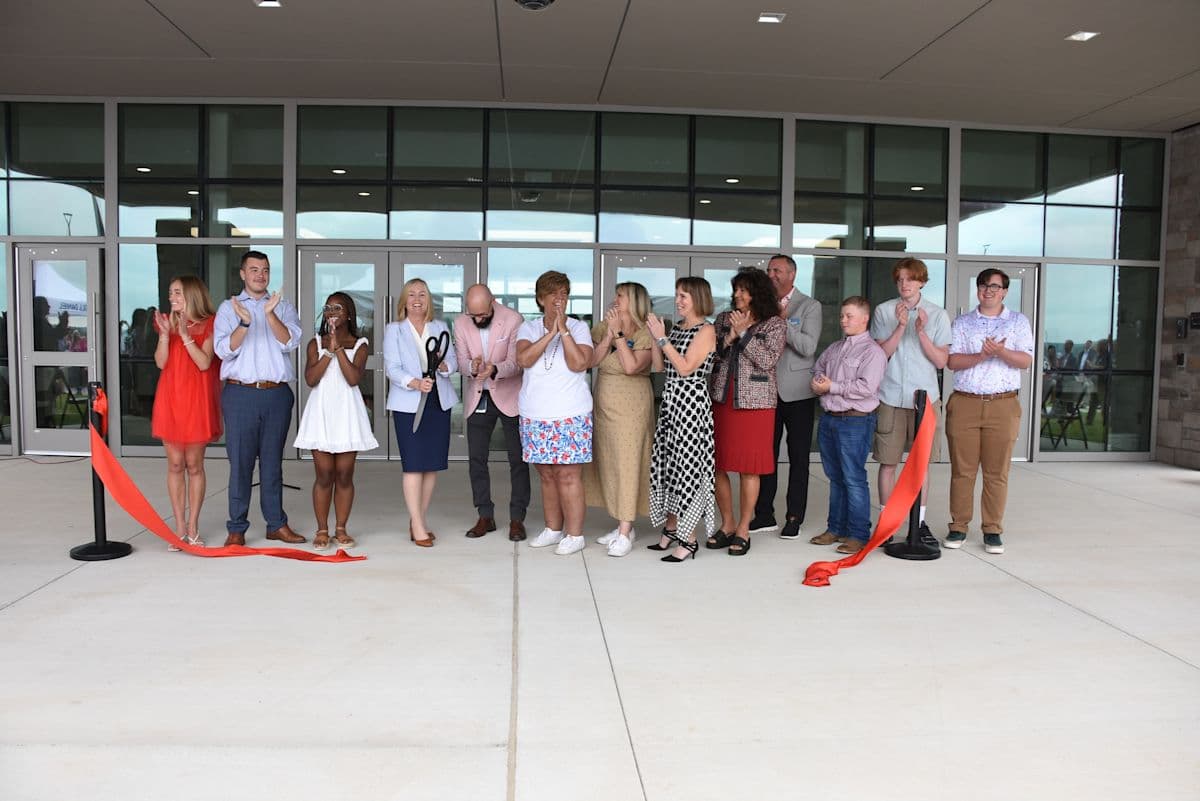
Cherokee High School Opens New $179 Million Campus in Canton
The replacement for Cherokee County's oldest high school opens Aug. 3, bringing 2,600 Warriors into a facility built for the next generation, and beyond
Woodstock Community News Staff|

Cherokee High Senior Ian Zeller Lands $10,000 National Merit Scholarship from Emerson Electric
The Class of 2026 standout, bound for aerospace engineering at the University of Alabama, is among the top 1% of U.S. high school seniors recognized by the prestigious program
Woodstock Community News Staff|