Cherokee County Students Set AP Pass Rate Record, Topping State and Nation
Woodstock Community News||1 min read
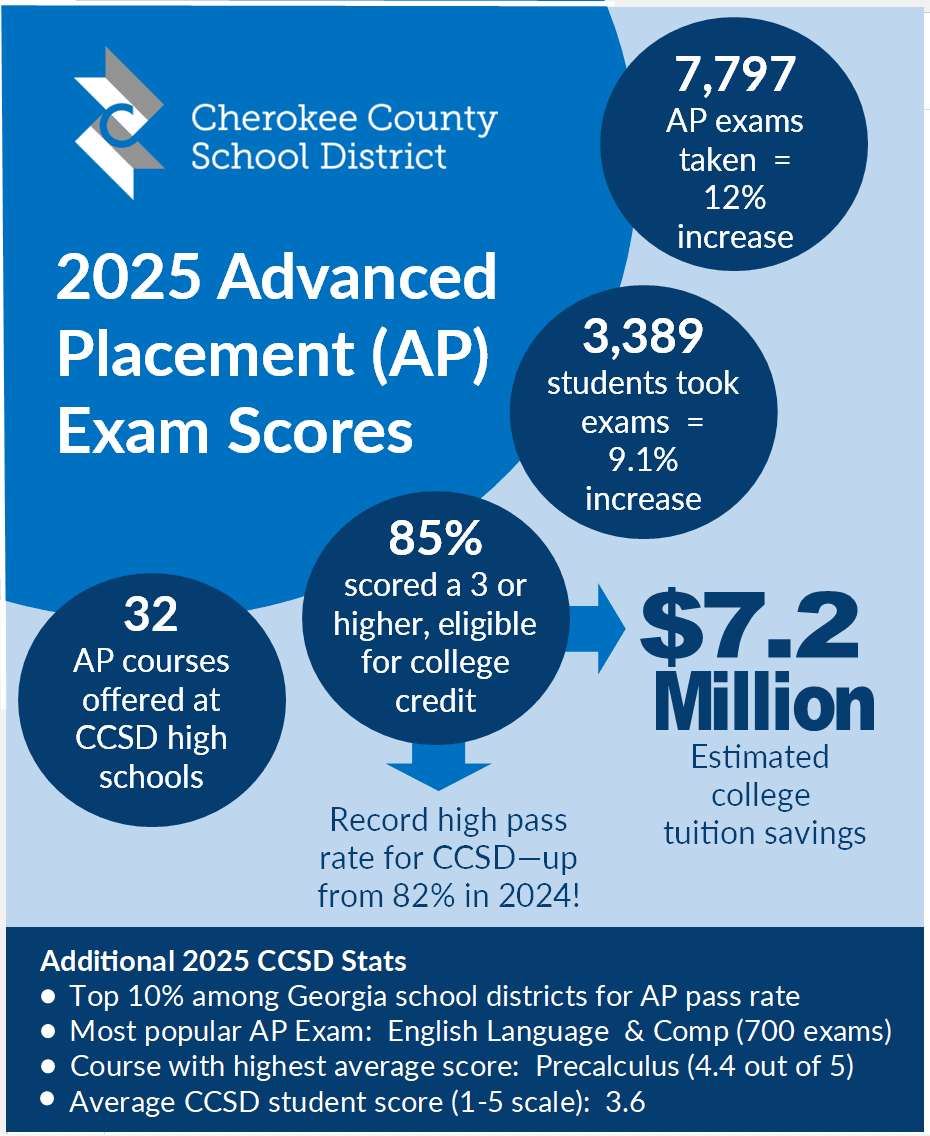
SUBHEAD: An 85.1% pass rate and nearly 3,400 students taking college-level exams translate to an estimated $7.2 million in tuition savings for Cherokee families.
BYLINE: Woodstock Wire Staff
SOURCE: [CCSD News - Cherokee County School District](https://www.cherokeek12.net/post-detail/~board/ccsd-comms/post/ccsd-increases-ap-pass-rate-to-record-high-exceeds-state-and-nation)
High school students across Cherokee County passed college-level Advanced Placement exams at the highest rate in district history last spring, with 85.1% of test-takers earning scores that qualify them for college credit, surpassing both state and national benchmarks.
The results mark a meaningful jump from the 82.8% pass rate the Cherokee County School District recorded the previous year, according to newly released data. To earn college credit at most Georgia colleges and universities, students must score a 3 or higher on a 5-point scale. The district's average score came in at 3.6, well above the passing threshold.
What makes the numbers more striking is how many students are now attempting these courses in the first place. A total of 3,389 Cherokee County students sat for AP exams last spring, a 9.1% increase over the prior year, and they collectively took 7,797 exams, up 12% from the year before. That combination of broader participation and higher pass rates puts the district in the top 10% of Georgia school districts for AP performance, according to CCSD.
The financial stakes are real for Cherokee County families. The district estimates that students' passing scores generated roughly $7.2 million in college tuition savings, as credits earned through AP exams can eliminate the need to pay for equivalent courses in college. Across 32 AP courses offered at CCSD high schools, students showed particular strength in Precalculus, which posted the highest average score in the district at 4.4 out of 5. English Language and Composition drew the most test-takers, with 700 exams administered.
For the families of Woodstock, Canton, and the other communities that make up Cherokee County, the record comes as the cost of higher education continues to climb. Every college credit earned in high school is one fewer credit, and one fewer tuition bill, waiting on the other side of graduation.
Share
Related

Rain Won't Fix This: Woodstock Under Level 1 Drought Response as Georgia's Water Crisis Deepens
Georgia EPD's formal drought declaration means Woodstock water customers must follow landscape watering restrictions even as wet weather moves through the area
Woodstock Community News Staff|

Woodstock Arts Opens Registration for Summer Visual Arts Classes
Offerings range from drawing fundamentals to watercolor travel themes and the traditional craft of shuttle tatting
Woodstock Community News Staff|

Cherokee High School Opens New $179 Million Campus in Canton
The replacement for Cherokee County's oldest high school opens Aug. 3, bringing 2,600 Warriors into a facility built for the next generation, and beyond
Woodstock Community News Staff|

Cherokee High Senior Ian Zeller Lands $10,000 National Merit Scholarship from Emerson Electric
The Class of 2026 standout, bound for aerospace engineering at the University of Alabama, is among the top 1% of U.S. high school seniors recognized by the prestigious program
Woodstock Community News Staff|